Oxford Historical Society, a 501 (c) 3 charitable organization
Twitchell Rowland Homestead Museum
P.O. Box 582, 60 Towner Lane, Oxford, CT 06478
Oxford Revolutionary Tales: Patriots, Tories, Kidnappings and More!

Saturday, February 28, 2 to 3 pm. Oxford Town Historian Dorothy DeBisschop looks at surprising events that happened right here in Oxford. This free program at the Oxford Library is for school age to seniors, kicking off America 250. Additional volunteers are welcome to help finish the work researching and documenting local patriots to celebrate Oxford’s role in achieving liberty and freedom in America. Various skills are needed on this project and interested people can find out more. This program is co-sponsored by the Oxford Historical Society. Oxford Library is at 49 Great Oak Road. Registration is requested: 203-888-4936 or on the library website.
Your Opportunities to Support Oxford Historical Society
Ion Bank’s Community Awards program offers their bank customers a vote to support community non-profits. Each online vote garners one chosen group a 125 donation from Ion Bank. One vote per person is the limit no matter how many accounts, but each signer on an account may vote. Check with the bank to vote without online access. Voting begins February 2 and ends on March 2, 2026.
This is a wonderful way to support activities in your hometown and community – and with someone else’s money!
This spring there will be two opportunities for online givint with donations being boosted by area foundations. The Connecticut Community Foundation’s Give Local 2026 will be held on April 21 and 22. The Valley Community Foundation’s Great Give, will follow.

2026 Fiber Fest ~ April 18 and 19.
Come peek into Oxford’s agricultural past at the annual Oxford Historical Society Fiber Fest on Saturday, April 18, from 10 am to 4 pm and Sunday, April 19, from 1 to 4 pm. This unique free program takes place on the grounds of the Twitchell-Rowland Homestead at 60 Towner Lane off Route 67 across from St. Thomas Roman Catholic Church. Look for the OHS sheep signs around town!
Local crafters will demonstrate using varied fibers for knitting, crocheting, weaving, crafting and more. The New England Lace Makers Guild members will show how hand made lace is produced when cobweb-like threads wrapped around colorful bobbins are twisted and knotted into centuries old, astonishing designs in this timeless craft.
Hand crafted fiber artists will be on hand offering a range of products. Vendors: Rose East – knitting and felting; Leila Orienter – hand knits; Gail Cameron – embroidery; Robin Zeigler – brooms; Mardi Smith – baskets; Kitti Deak – herbs; June Bissonette – alpaca farm; Katherine O’Keefe – Pink Petticoats children’s clothing; Carol McElroy – Red Oak Weaving. More crafters are welcome.
Demonstrations of weaving on the historic Jensen Barn Loom which fills one room of the museum will be given by Jan Galloway, Val Nelson, Linda Scinto and other volunteers.
The event is held rain or shine, and weather permitting visitors can watch shearing of alpacas, goats or sheep for the spring. The museum and the newly restored Munn schoolhouse are open for free tours. Docents will be available to chat about the house built in 1755 by the Twitchells and the one room schoolhouse used in 1850 by Marcus Munn as a classroom for his boarding school on Oxford Road. Both buildings were relocated to the historical society campus to prevent their demolition.
Litchfield Hills food truck will sell fried dough. Homemade treats will be offered as well. Books and notecards produced by the Oxford Historical Society members will also be available for sale. These titles feature the old houses and buildings in Oxford, the history of local railroads, and veterans of various wars and conflicts. The society’s notecards offer both photo-based scenes of the Stevenson Dam construction a century ago as well as historic views from the Society’s collections, and the newest designs, Claudia Farkas’s architectural prints of five of Oxford’s historic homes.
All sales and donations from this event benefit the Oxford Historical Society and are focused on supporting programs and preservation activities.
Heritage Recipes: LOCAL OXFORD COOKBOOKS
In the Twitchell-Rowland Homestead Museum files is a 1916 copy of “Choice Recipes”, published by The Ladies Social Circle of the Congregational Church, Oxford, CT. It was a gift from Beulah Renker, and belonged to her grandmother, Mrs. Frederick Dahinden. The cookbook is complete with splashes and stains showing that it was well used. Unlike many cookbooks published by local groups, this was professionally typeset and bound, the costs no doubt defrayed by the 36 businesses who subscribed to have their advertisements printed in the booklet. However, many groups chose to type and bind their recipes themselves to save money. Another one from the Quaker Farms Homemakers Club has an oilcloth cover, ring binders and hand typed contents.
Publishing a cookbook was a way that women could raise money for a cause, using what they knew best: their cooking skills. The Oxford Historical Society’s collection includes publications by local churches, the Junior Women’s Club, the Garden Club, the Quaker Farms Homemakers, and the PTO, stretching into the twentyfirst century. This span of time gives us a look at how our town’s food ways changed over the years and how the expertise of the woman stirring the pot altered as stoves improved from wood-burning ranges to propane and electricity-fueled stoves to microwaves.
pes, “To make creations from this book you will need to use a modern cookbook to get their cooking temperatures and time(s) as our forbears did their cooking and baking with a wood stove with no oven controls.” Also, the ingredients reflect what could be grown in the family garden, purchased at the local general store or from a peddler in the earlier book. Later, they were available from a nearby grocery store. Two recipes, the first from 1916, now over a century ago, and the second from the 1972 Christ Church Cookbook illustrate these changes in cooking techniques.
As Beulah warns in a reproduction copy of Choice Recipes, “To make creations from this book you will need to use a modern cookbook to get their cooking temperatures and time(s) as our forbears did their cooking and baking with a wood stove with no oven controls.” Also, the ingredients reflect what could be grown in the family garden, purchased at the local general store or from a peddler in the earlier book. Later, they were available from a nearby grocery store. Two recipes, the first from 1916, now over a century ago, and the second from the 1972 Christ Church Cookbook illustrate these changes in cooking techniques.
Oatmeal Bread (1916) – Ruth Sanford
- Three cups oatmeal
- 2-3 cup molasses
- 1 tablespoon lard
- 3 cups boiling water
- 1 yeast cake
- salt
Pour boiling water over oatmeal. When cool add molasses, lard, salt and yeast and white flour to stir stiff. Put in tins and when light bake.
All of the ingredients for this bread would have been available at the general store. Note there is a complete lack of baking time or temperature. Ruth Sanford knew her stove and her bread baking by heart.
In the over fifty year old 1972 copy of the Christ Church Cookbook: Oatmeal Bread (1972) (Elizabeth Twitchell)
- 1 cup Quaker Oats 1 tsp. Salt
- 1 pt. boiling water 1 quart bread flour
- 1 tbsp. Butter
- 1⁄2 cup molasses 1 yeast cake
Mix oats, butter, salt, molasses, and water in large bowl and cool. Add yeast and flour and let rise 7-10 hours. Turn out on floured board; add flour if necessary but keep soft. Put into two 4″ x 8″ bread pans. Allow to rise to top of pans. Bake at 350 F. about 1 hour.
Mrs. Twitchell’s recipe for the same bread is far more specific and easier to follow, especially since she had a stove with an oven thermostat.
As mentioned before, the 1916 copy of Choice Recipes features ingredients that could be locally purchased or that were produced at home.
Here is a “receipt” for Chocolate Pudding
- One quart milk
- 6 eggs
- 1 square chocolate
When milk boils stir in grated chocolate, then beaten yolks and 1-2 cups sugar.
Bake in oven same as custard, must not whey [sepa-
rate].
Beat whites with 1-2 cup sugar for meringue. Serve cold with fresh sweet cream. – Mrs. Philip Rowland
Elizabeth Rowland’s milk, cream and eggs for this dessert all would have been produced at the family farm on Christian Street. Chocolate and sugar would have been obtained at the general store.
By contrast, here is a classic recipe from the 1970s for a gelatin salad from the 1972 Christ Church Cookbook:
Cherry Salad Supreme – Laura Stanton
- 3 – oz. pkg. raspberry flavor gelatin
- 2 cups boiling water
- 3 -oz. pkg. lemon flavor gelatin
- 21 oz. cherry pie filling
- 3 oz. cream cheese
- 1/3 cup mayonnaise
- 1 cup pineapple, crushed
- 1⁄2 cup cream
- 1 cup tiny marshmallows
- Chopped nuts
Dissolve raspberry gelatin in 1 cup boiling water. Add pie filling; pour into dish; chill until firm. Mix together cream cheese and mayonnaise. Dissolve lemon gelatin in second cup boiling water. Add to cheese and mayonnaise. Stir in undrained pineapple; set aside.
Beat cream until stiff; add to lemon gelatin. Add marshmallows and pour entire mixture over chilled cherry pie filling. Sprinkle with chopped nuts. Chill until firm.
Unlike Elizabeth Rowland’s chocolate pudding, Laura Stanton’s gelatin salad’s components were nearly all purchased at the grocery store. Only the water came from her kitchen tap.
There is one important development that occurred between 1916 and 1972 that has nothing to do with recipe directions or ingredients. Unless they were unmarried like Nellie Hine or Ruth Sanford or widowed like Mrs. Mary Miles, the women who contributed to the 1916 Choice Recipes all were identified by their husband’s names: i.e., Mrs. E. B. Harger and Mrs. William Whitehead. By the time the women of Christ Church published their 1972 cookbook, married or not they used their own, given names: i.e., Eleanor Foster and Agatha Wyler. We’ve come a long way, baby.
CD PLAYER WANTED:
Do you have a CD player in your closet that you would like to unload? The Oxford Historical Society is looking for a small working CD player to provide background music for Homestead events. If you have one you’d like to donate, please contact Nancy Farnum at 203-888-0230. Thank you.
On Display: Light in the Winter Nights
Recalling the cold and dark that the early families living in the Twitchell Rowland house endured, a special display is on offer that features 17 th and 18 th century lighting devices that would have brightened their evenings and allowed them to continue their day’s work. The items are from the collection of society President Rob Buck.
Open Houses Scheduled

We will host open houses on January 4 and 18, and February 1 and 15, from 2 – 4 pm. Each month on the first and third Sunday the Twitchell-Rowland Homestead is open to the public. Docents chat about the history of the house and the items found inside as well as other topics of interest to the community. Admission is free, all ages welcome.
Books produced by the Society are available for purchase as well as unique notecard sets created using local art and photographs. Proceeds benefit the society’s events and activities plus maintenance of the buildings and grounds.
Help Us Make More History
The Oxford Historical Society has launched its America 250 Project documenting the lives and records of Oxford’s veterans of the American Revolution for preservation in multiple formats.
Over a dozen local volunteers of all ages are already working to research period records and locate veterans’ headstones in local cemeteries. More people will be needed to record the information found: photographers, readers and writers, video/sound recorders and tombstone cleaners and more.
America 250 may offer volunteers options for fulfilling community service, Eagle or Gold Scout, or Capstone project requirements. History buffs are especially welcome. Membership in the Oxford Historical Society is not required. Interested persons may call Dorothy DeBisschop at 203 910-4574.
WHO’S THAT? A HISTORY OF OXFORD ROAD NAMES
One of the first questions Oxford newcomers ask is “Did a governor really live on Governor’s Hill Road?”
The answer, according to John Warner Barber, who wrote sketches of each Connecticut town and briefly commented on it between 1834 – 1836, lies in the sly Yankee humor of the times. Governor’s Hill, he wrote, got its name because the owner of the property thought he was better than his Oxford neighbors. He devoted much of his time to court appearances defending his “real or imaginary rights.” Town records don’t offer us a name for this crochety and no doubt unpopular man, but his nickname has been preserved until the present, even on road signs.
Until the 1980’s, the area was mostly woodlands and wetlands, plus Connecticut’s most famous crops – rocks and ledges. Beers’ 1868 map shows few homes on the road. Today there are a few surviving. Numbers 6, 77 and 89 are at the foot of the hill where it intersects with Oxford Road. The former Perry Academy and Homestead just west of St. Peter’s Cemetery, was demolished and the cellar hole filled in. That property now belongs to the Oxford Land Trust. At the opposite end, Number 306 is at the top of Governors’ Hill where the road meets Quaker Farms Road.
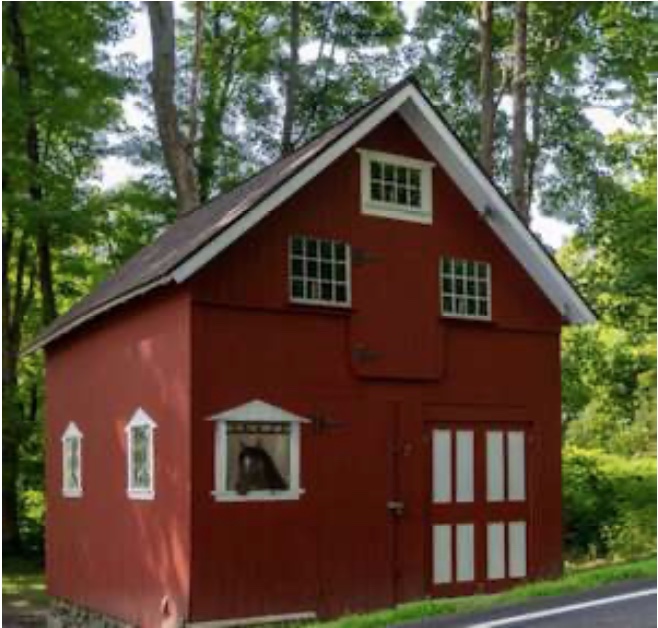
Number 6 Governor’s Hill is believed to have been built on the banks of the Little River about 1738. Over the years it was left empty for a time then suffered from extensive fire damage at another point. In the last 5 years there has been significant clean up and renovation. The barn across the street is notable for the painted horse peering out the trompe l’oeil painted window.
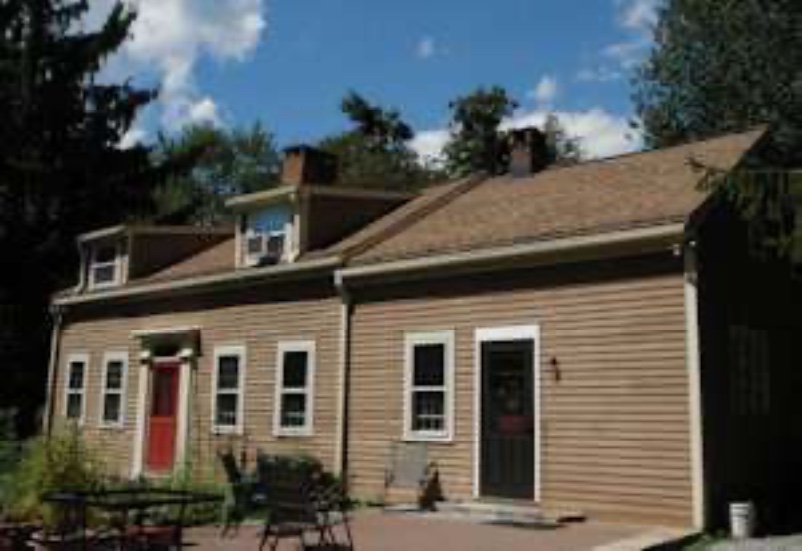
Numbers 77 and 89 were owned by members of the Perry family at various times. 89 was built by Captain Joel Perry for his bride, Elizabeth Riggs in 1790. At his death in 1856 the house was bequeathed to his maiden daughter Eunice, to be shared with her brother Nathan. The will contains specific details to ensure Eunice Perry’s rights were protected.
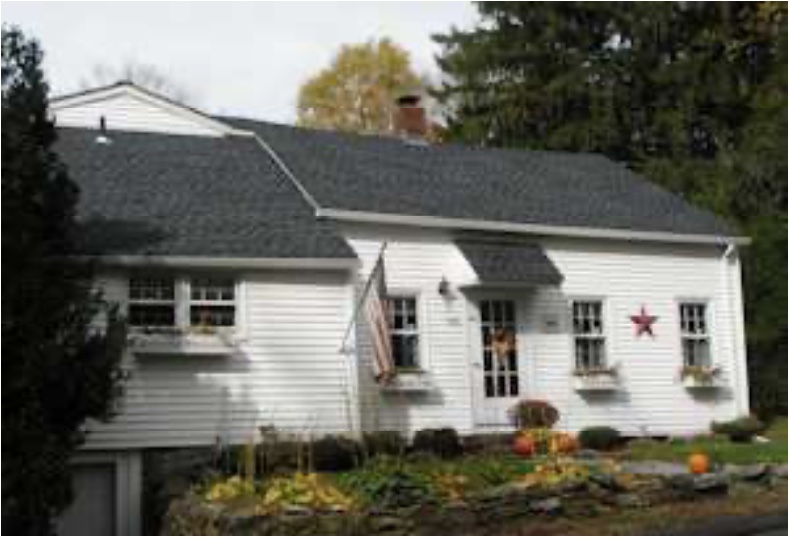
Number 306 is built very close to the road but has no specific date for its construction. It is listed on Beers’ 1868 map with the name Wheeler and a blacksmith designation. The names Sanford and Carpenter are also associated in the local records. A deed in 1911 described this as “the old homestead” and connects it to a barn and blacksmith shop. Over the years horseshoes, hinges and latches have been found while digging, supporting the blacksmith operation there.
Oxford has had its ups and downs in population trends. In 1800, shortly after the town was incorporated, it had just over 1,000 residents. The number increased slightly and then decreased, until it reached an all-time low of just 902 residents in the 1890s. In the 1950s, Oxford’s population reached 2,000. By 1970 it doubled to 4,480 and in 1980 it was 6,634. It has been rising substantially ever since. Today’s population is over 12,000.
The modern era began a time of rapid population growth and subsequent new home construction in town, some of it centering on Governor’s Hill. Family names associated with early residences on the hill include Sperry, Perry, Carpenter, Wheeler and Sanford.
Much of this information comes from materials available for purchase at the Twitchell-Rowland Homestead including the 1868 F. W. Beers map indicating Oxford school districts and showing residences, businesses and community landmarks. The book “Historic Buildings of Oxford Past and Present” was compiled and written by society members and published by the Oxford Historical Society in 2017. House photos were taken by Raymond Paul Doyle. The barn photo was taken by Sal DeFini and posted on Facebook.
Membership Dues for 2026
OHS membership is due for renewal for 2026 and the rates have not changed! Forms can be downloaded at the OHS website. Mail forms and checks to OHS, PO Box 582, Oxford, CT 06478. Individual memberships are 115, Seniors and Junior Associates (under 18) 110, Families 125 and Business Supporters (1200).
Member dollars help with society expenses and activities, and the numbers of members are used by grant givers as an indication of involvement with the community. Also listed are opportunities for volunteering. Be sure to check those that appeal to you. Being a member really counts for us!